

America's Learning Crisis: Reading Down in 83% of Districts, Math Down in 70%-When are we Going to Say Enough is ENOUGH!!!!
How Much More Evidence Do We Need?
The latest Education Scorecard findings should stop every parent, educator, policymaker, and school leader in their tracks.
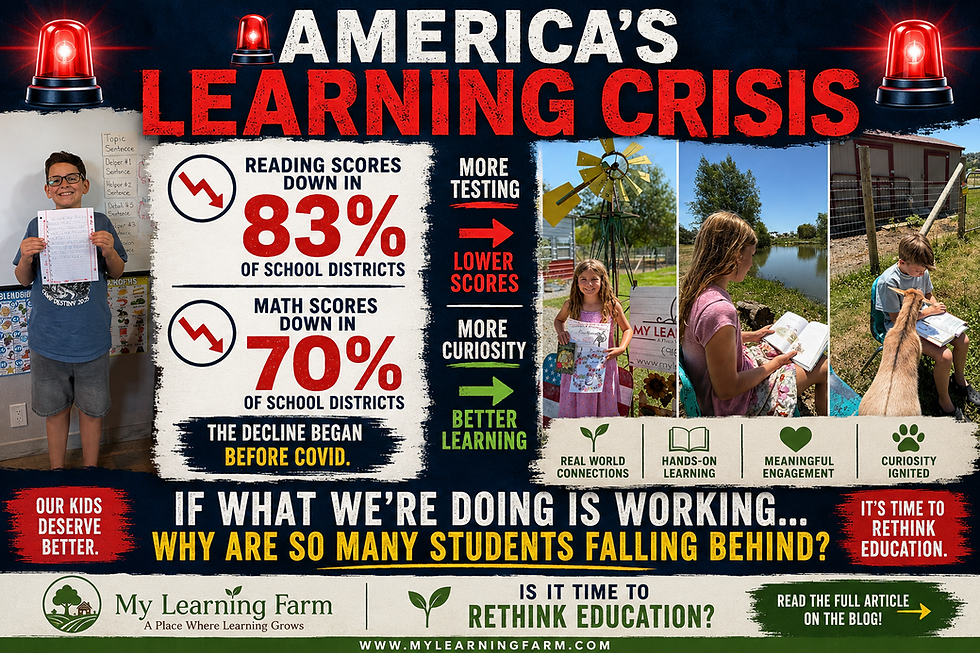
According to researchers from Harvard, Stanford, and Dartmouth, reading scores are lower in 83% of school districts than they were a decade ago. Math scores are lower in 70% of districts. Even more concerning, researchers report that the decline began long before COVID-19. The pandemic may have accelerated the problem, but it did not create it.
Read the full Education Scorecard report here:https://educationscorecard.org/
For years, we have heard explanations.
It's social media.
It's smartphones.
It's COVID.
It's absenteeism.
Those factors certainly matter. But when reading declines in 83% of districts and math declines in 70%, perhaps it's time to ask a bigger question:
What if the system itself needs to change?
As both a parent and an educator, I don't believe we can continue doing the same things and expect different results.
The Learning Recession Didn't Start With COVID
One of the most striking findings from the Education Scorecard is that researchers identified a "learning recession" that began around 2013. Student achievement was already trending downward years before school closures occurred.
That should force us to examine every aspect of modern education:
Curriculum
Teacher preparation
Assessment systems
Homework expectations
Classroom engagement
Technology use
Educational policies
Funding priorities
If the current approach were working, wouldn't we be seeing better outcomes?
Why Aren't We Looking More Closely at What Is Working?
Across the country there are bright spots. Some charter schools are producing strong academic outcomes. Many homeschool students are thriving. Several states that embraced the Science of Reading are beginning to see reading improvements. Louisiana, for example, has shown notable gains after implementing evidence-based literacy reforms focused on phonics and structured literacy.
Internationally, countries such as Finland are frequently studied for educational practices that emphasize teacher preparation, student well-being, and meaningful learning experiences. So why aren't we spending more time studying success? Why do innovative models often remain on the sidelines while struggling systems continue to dominate the conversation?
Learning Should Be Meaningful
Children are naturally curious.
They ask questions.
They explore.
They build.
They create.
Yet many classrooms continue to rely heavily on worksheets, test preparation, and instructional approaches that fail to ignite a love of learning.
What if we redesigned education around how the brain actually learns?
What if teachers received extensive training in:
The Science of Reading
The Science of Learning
Memory and retrieval practice
Cognitive load theory
Explicit instruction
Executive functioning
Attention and engagement
What if learning was more hands-on, project-based, discussion-based, and connected to the real world? And what if teachers could teach to the students in their classrooms without worrying about the boex to be checks, the standards to be introducted or the assessments needing to be administered and let education unfold more naturally? What if we focused less on compliance and more on curiosity?
A Hard Question About Common Core
Many families and educators have expressed frustration with Common Core implementation over the past decade. The promise was higher standards and improved outcomes. Yet the national data raises an uncomfortable question:
If student achievement has been declining for more than a decade, shouldn't every major educational initiative be open for review?
That doesn't mean abandoning rigor. It means having the courage to examine whether our current standards, curriculum choices, instructional methods, and accountability systems are producing the results our children deserve. No program, policy, or framework should be beyond questioning.
Our Children Cannot Wait
The most heartbreaking part of these statistics is that behind every percentage is a child. A child who struggles to read. A child who believes they are "bad at math." A child whose confidence shrinks year after year. A child who begins to believe learning isn't for them. We know more today about how children learn than at any other point in history. We understand the importance of explicit instruction. We understand the Science of Reading. We understand the value of early intervention. We understand the importance of engagement, relationships, movement, play, and meaningful practice. So the question isn't whether solutions exist. The question is whether we are willing to embrace them. Because if reading is down in 83% of districts and math is down in 70%, perhaps the conversation should no longer be about how to make small adjustments around the edges.
Perhaps it's time for a fundamental rethinking of education itself. Our children deserve more than declining scores. They deserve schools that help them discover their strengths, build their confidence, develop their skills, and fall in love with learning. The data is speaking. The question is: Are we listening?


Comments