

What the United States Can Learn from Finland’s Education System
When people talk about Finland’s education system, it can sometimes sound like a fairy tale: children with more play, less testing, highly respected teachers, and schools built around trust. But Finland is not magic. It is not perfect. And it is not the United States.
Still, there is something deeply hopeful about looking at a country that chose, very intentionally, to build an education system around equity, teacher professionalism, child development, and support for all learners.
At My Learning Farm, I spend a lot of time with children who have been bruised by school. Bright children. Creative children. Capable children. Children with dyslexia, dysgraphia, dyscalculia, ADHD, anxiety, and other learning differences. Many of them arrive believing school is something to survive rather than a place to grow.
That is why this conversation matters.
Not because the United States should copy Finland exactly, but because we can learn from the values beneath their system—and we can choose to move the needle here at home.
Finland Starts with Equity
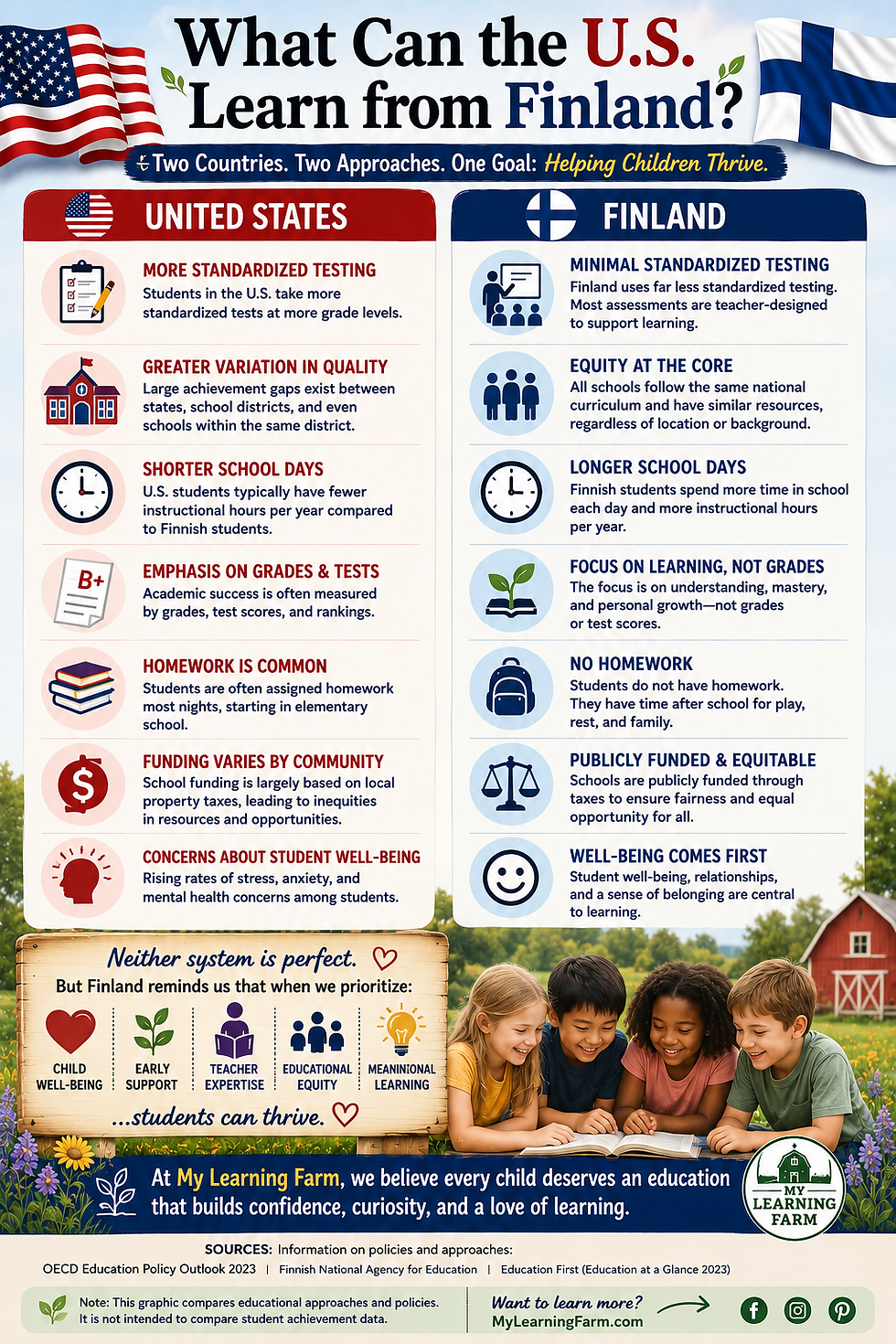
One of the most important foundations of Finland’s education system is the belief that every child deserves access to a strong education, no matter their background, neighborhood, or family income. Basic education in Finland is free and designed for all children. The national curriculum provides a shared foundation, while still allowing local communities and teachers flexibility in how they teach. This balance is powerful.
There is a common standard, but not a one-size-fits-all script. There is structure, but also professional trust. There is accountability, but not through constant pressure on children. In the United States, we talk often about equity, but our system is still deeply affected by zip code, school funding, access to early intervention, and whether families know how to advocate. Too many children must struggle for years before receiving the support they need.
We can do better.
Finland Trusts Teachers
One of the most striking differences between Finland and the United States is how teachers are viewed. In Finland, teachers are highly educated, respected professionals. Schools and teachers have meaningful autonomy to design instruction based on the needs of their students. The national curriculum guides learning, but teachers are trusted to bring it to life.
In the United States, many wonderful teachers are working incredibly hard inside a system that often asks them to do too much with too little. They are handed pacing guides, testing schedules, large class sizes, behavior challenges, curriculum changes, and paperwork—then expected to meet every child’s needs.
If we want stronger schools, we must support teachers as professionals. That means better preparation, meaningful collaboration time, smaller class sizes when possible, high-quality curriculum, and trust in teacher judgment. A thriving classroom begins with a supported teacher.
Finland Focuses on the Whole Child
Finland’s education system places a strong emphasis on student well-being. Learning is not treated as separate from childhood. Children need movement, relationships, safety, play, food, rest, and time to develop. This is something we know in our bones at My Learning Farm.
Children learn best when they feel safe. They take academic risks when they feel connected. They build confidence when adults notice their strengths, not just their weaknesses.
In the United States, many children experience school as rushed, pressured, and overwhelming. The pace can be especially hard for students who need explicit instruction, repetition, multisensory teaching, or extra processing time. A hopeful shift would be to ask not only, “How do we raise test scores?” but also, “How do we create learning environments where children feel capable, calm, connected, and ready to learn?”
Finland Intervenes Early
Another important lesson from Finland is the value of support before failure becomes a child’s identity. Rather than waiting for students to fall far behind, Finland has historically emphasized early support, prevention, and flexible help within the school system. The goal is not to label children as broken. The goal is to notice needs and respond. This matters deeply for students with learning differences.
A child with dyslexia should not have to fail for years before receiving structured literacy. A child struggling in math should not be told to “just practice more” when they need explicit, concrete, sequential instruction. A child who melts down over writing may need support with language, motor planning, spelling, executive functioning, or all of the above. Early support changes lives.
Finland Is Not Perfect—and That Makes the Lesson More Useful
It is important to say this clearly: Finland’s education system is facing challenges too. Recent international assessment data shows that Finland’s scores have declined in math, reading, and science. Finland is actively working on reforms to address these concerns.
The lesson is not, “Finland has everything figured out.” The lesson is, “Finland built a system around values worth studying—and when challenges appear, they continue adjusting.”
The United States does not need to become Finland. We are larger, more diverse, more locally controlled, and more complex. But we can still ask better questions.
What would happen if we valued teacher expertise more? What would happen if early intervention became normal instead of difficult to access? What would happen if reading instruction was evidence-based everywhere? What would happen if math instruction moved from memorization and speed toward deep understanding? What would happen if we measured success not only by scores, but by confidence, curiosity, resilience, and long-term growth?
Moving the Needle in the United States
Changing an education system is not simple. It takes policy, funding, teacher training, leadership, and community voice. But change also begins in smaller places. It begins when a parent says, “My child needs something different.”
It begins when a teacher says, “This student is capable, and I am going to find the way in.”
It begins when schools choose evidence-based reading instruction. It begins when math is taught in a way that makes sense to the brain. It begins when we stop asking children to fit the system and start asking how the system can better support children.
At My Learning Farm, I see what happens when children are given the right tools, the right environment, and the right encouragement. I see students who once felt defeated begin to bloom. I see reluctant readers become proud readers. I see children who feared math begin to understand it. I see confidence grow one small success at a time. That is how fields are planted. One seed. One child. One shift. One brave change at a time.
Finland reminds us that education can be built on trust, equity, support, and hope.
And here in the United States, we have the opportunity—and the responsibility—to keep moving the needle for our children.


Comments